Put yourself at your desk, with MT5 glowing on the screen. Now you are torn by two voices. One is a human being: a Telegram ping of an analyst who has just realized a juicy EUR/USD setup. The other one is mechanical: your Expert Advisor groaning like a machine, sweeping through all the ticks with machine patience.
This is the dilemma of the modern trader: manual or automated EAs.
No magic wand is provided in either of them. Just because you go by the signal or place a bot, profits do not drop. The important things are the quality of the strategy, the discipline of risk management, and the trader behind the tool.
In this blog, Primefx unpacks the idea of performance reliability, lifestyle fit, and risk, and how both approaches work in practice.
Note: This is not investment advice; this is educational. Trading is risky, and the past does not predict the future.
Manual signals are the human heartbeat of trading. They are created by analysts who study all night, reading charts, fundamentals, and sentiment, and then distil their insights into clear instructions. Sent through Telegram, they appear to resemble the following:
Pair: XAU/USD
Direction: Buy
Entry Zone: 1025.00
Stop Loss (SL): 1020.00
Take Profit (TP): 1035.00
Risk Note: "Risk 1-2% per trade"
Simply, the analyst performs the analysis, and you transfer the trade to your account (or a copier does it).
At Primefx, we maintain clean signals: 1 SL, 1 TP, and no clutter. The intention behind that simplicity is to minimize confusion, instill discipline, and ensure transparency of risks.
Numbers are not the only manual signals. They're lessons. Every trade is a peephole into how an analyst thinks: why they made this entry, why the SL is set, and why the TP is realistic. Signals are real-time textbooks for traders who want to learn.
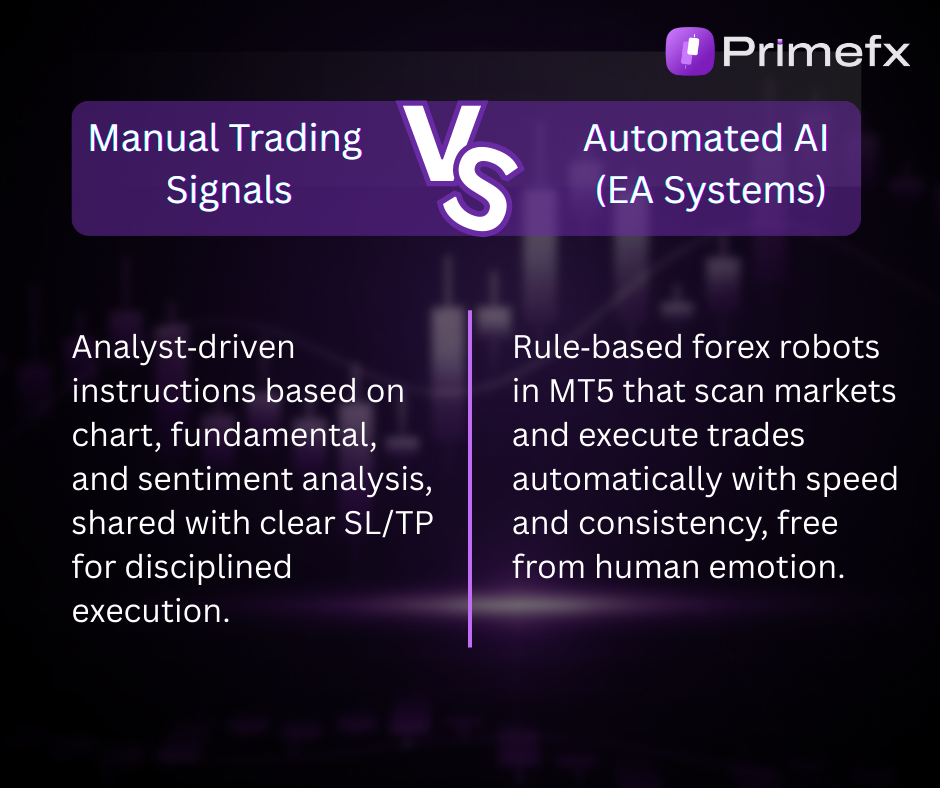
The forex robots are automated EAs. They reside in MT5 and are written using directives for indicators, price patterns, and timing. Being turned on, they search in the market and automatically trade on them. No clicks, no hesitation, no “Should I, shouldn’t I?” drama.
Automated EAs don't think like humans. They do not mind making or being in the news. The only difference is that they prioritise consistency and speed.
If the rule reads 'to buy,' the EA will buy, whether you are sleeping, at work, or binge-watching Netflix.
The discipline of EAs is their beauty. They do not pursue losses, they are not greedy, and they do not miss trades because the chart looks scary. But their weakness is in rigidity. Unless you update the code, the EA will not adapt to a new market regime (e.g., volatility spikes after a geopolitical shock).
Then there is the million-dollar question: who does it better, a man with his sloppy intuition and gut feel, or a machine with its cold accuracy?
We should disaggregate it, not into boring bullet points, but into the drama of the trading floor.
There is the scenario of an analyst drinking coffee at 3 a.m., reading charts. At the same time, Bloomberg headlines appear on the screen. The Federal Reserve announces an unexpected political burst.
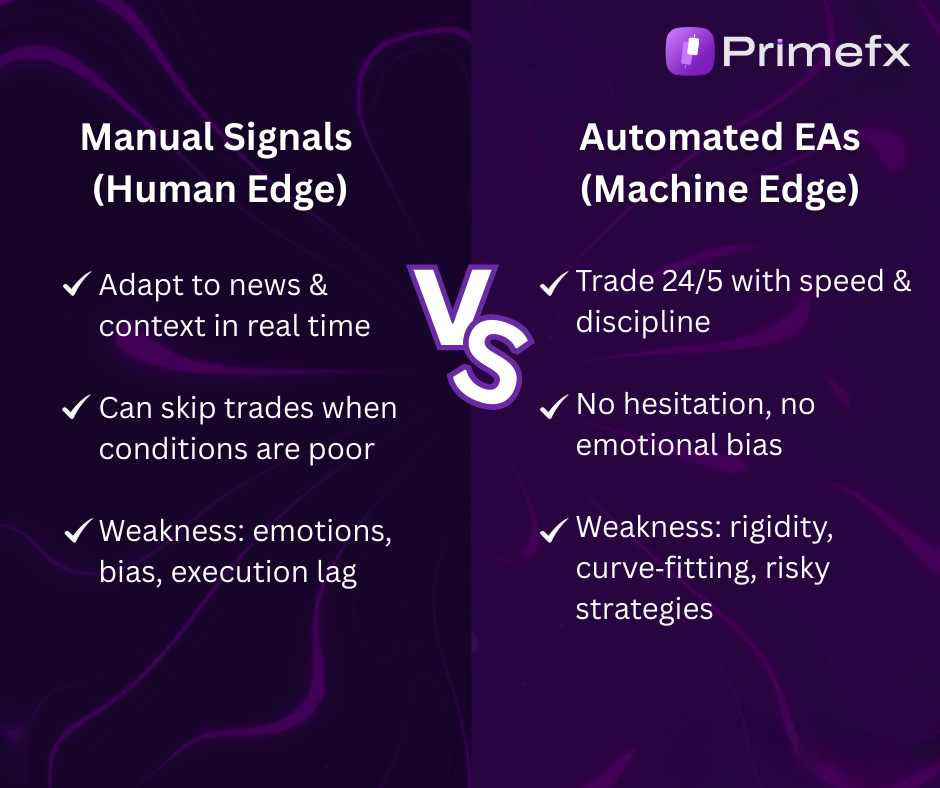
A human being can consider new information and context that no backtest could have observed previously. That is the advantage of manual signals; they breathe with the market.
Even better, the analysts can choose not to trade when the conditions are not right. Perhaps the chart is textbook-perfect, but liquidity is thin, and sentiment is weak. An experienced human will understand when to make a way and save capital rather than impose a setup.
But humans are, well, human. Bias sets in. Revenge trading when you are down, overconfidence when you are up, and simple fear in times of volatility spikes.
These are the emotions that can destroy your performance. And then there is execution lag: subscribers tend to get into trades a few seconds or even minutes later, at worse prices, and convert what appeared to be a +50-pip win into a scratch or even a loss.
Imagine the EA now: no coffee, no nervousness, no hesitation. It’s a tireless worker, scanning markets 24 hours a day, five days a week, ready to pounce in milliseconds. Ultra-fast execution, with no missed entries and no slippage due to indecision.
And what is its greatest strength? Discipline. The EA is not concerned that the three previous trades were losses. It never follows any note, never sulks, never boasts. Each signal programmed in its logic is performed exactly as written. Pure consistency.
However, machines have blind spots. Most EAs are curve-fitted. They perform perfectly during backtesting but fail miserably when the real world changes.
Then there come the martingale or grid strategy bots: the dangerous ones. They appear as profit factories until some extreme action wipes away months of profits in a single night.
So, who wins? The fact is that neither of them is put on the crown by default.
Manual signals can shine in chaotic, news-driven markets. This is because human judgment is an important factor.
Automated EAs dominate in fast, repetitive environments where speed and discipline reign supreme.
The competitive advantage does not lie in the choice between manual and automated approaches, but in the quality of the underlying strategy. Also, the strictness of the risk management. A human analyst who is sloppy and a bot that is reckless fail. Both a strict analyst and a well-coded EA flourish.
Human reliability is relied on in manual signals. Did you get the message in time? Did you stick to the SL and TP? Was the provider staying within their discipline?
The automated EAs rely on infrastructure. Is your VPS running? Is your broker stable? Does the code support new volatility in the market?
Bots never get tired; they just become outdated.
So reliability is divided into two segments,
manual = human discipline
EA = tech discipline.
Each of them can fail in its own way.
Risk management is the unspoken saviour of trading: the invisible seatbelt that will save your life when the market becomes volatile. But it is the place most traders neglect until it is too late.
Manual signals typically come with a stop loss (SL), a take profit (TP), and occasionally a gentle warning of the risk of each trade. Here, the lot size is controlled by subscribers.
Make a bigger play or even skip the SL even once, and now you are getting performance nowhere near the track record of the provider. It is as if one is given a parachute and fails to unzip the cord.
The advantage of manual signals lies in their clear entry, exit, and risk lines. But the weakness is in the human factor. Punishment is a choice. And most traders sabotage themselves by failing to follow the strategies designed to protect them.
They are properly coded. EAs may become the strict parent of your dreams. They have predetermined risk regulations: lot size, maximum trades, and position risk percentage. No negotiation, no “just one more trade.” When the rule is 2% max risk, that is what you have.
But not all bots are saints. There are those who either do not use hard stops or use martingale/grid strategies, doubling up until the account bursts. That is not risk management. That is gambling in code. It works well in backtests, but in real markets, it is a time bomb.
We feel that the risk structure is more important in Primefx than the execution style. The principles are the same regardless of the system you are operating. Whether it is based on manual signals or an EA, namely 1 SL-1 TP, a 1:2 ratio of risk to reward, and a maximum amount of risk per trade that keeps you in the game.
Flashy bots and emotional signals may grab attention, yet it is the dull ones that matter. Consistent risk rules build longevity.
The first victory in trading is survival, and risk management is the key to winning it.
Traders who would like to learn should use manual signals. You are in line with the logic, the markups on the chart, and the commentary. You grow with the analyst. But you must be there on hand to do it when the signal falls.
Traders with hectic lives prefer automated EAs. The bot does not care whether you are in a meeting or asleep. It runs without feelings. Ideal in cases when it is required to cut winners early enough before they place stops based on fear.
Learning vs. outsourcing: signals instruct, EAs act. The combination of the two is a powerful strategy: learn from signals and then automate the logic later.
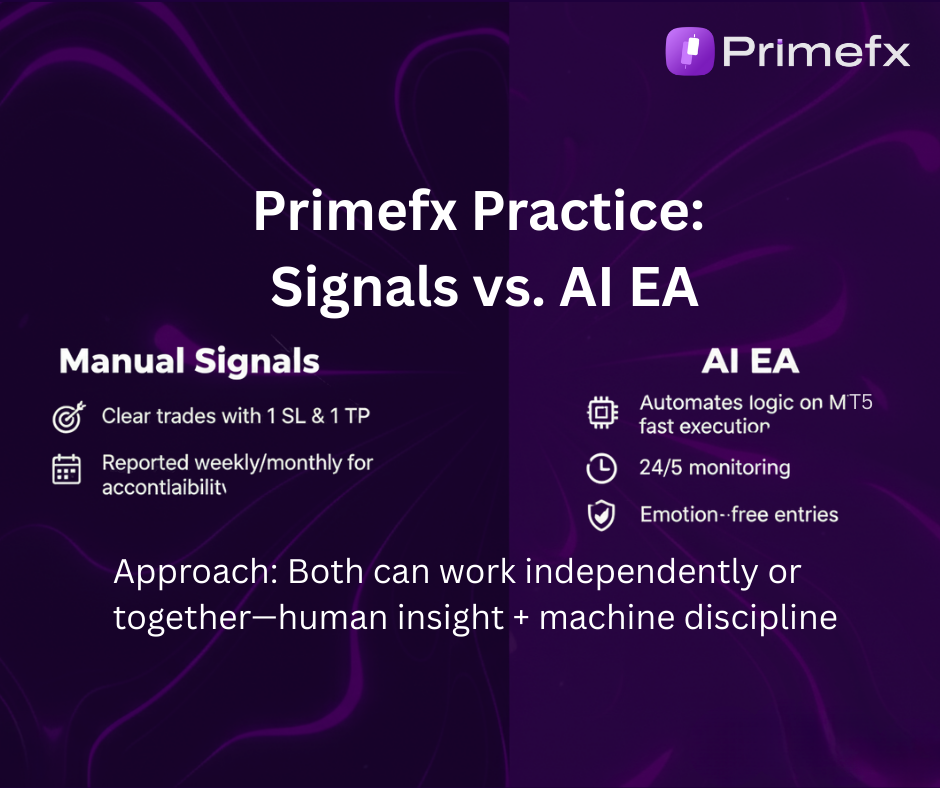
We do not force a decision at PrimeFx. Our manual signals provide straightforward, clear trades with 1 SL and 1 TP on forex and XAU/USD. Performance is reported weekly and monthly to ensure accountability.
Our AI EA automates both types of logic on MT5, providing faster execution, 24/5 monitoring, and emotion-free entries.
We present both as instruments that can operate independently or in combination. It is a sweet spot of human analysis and automation.
Manual signals can be appropriate for you when:
You call to know the reasons why trades are made.
You do not mind being on screen while active sessions are in progress.
When big news comes, you like human interpretation.
Automated EAs may suit you if:
You require 24/5 performance and a restricted time.
You struggle to make emotionally driven decisions.
You are comfortable with testing and updating algorithms.
Mixed strategy approach:
Learn high-impact trades using manual signals.
Conservative (risk) EA with entries.
Primefx ecosystem embraces this combination.
Which is more profitable: manual signals or automated EAs?
Both are not necessarily more profitable. Success is determined by the strategy, risk management, and discipline that underpin it.
Do EAs eradicate emotional trading?
They eliminate emotional execution, yet traders still make decisions about risk settings and pause systems.
Are manual signals better for beginners?
Yes, they are useful for teaching beginners the art of reasoning and analysing charts, but errors in execution can reduce performance.
Can I run manual signals and an EA on the same account?
Yes, but stacking drawdowns can occur between risks. Clear limits are essential.
How should I test an EA before trusting it with real money?
Backtest, demonstration, then small live accounts with a severe risk cap.
How do I verify whether a manual signal provider or EA seller is legitimate?
Search transparency, verified reporting, and no red flags. We have an article on scams/red flags, see it.

Sofia Alvarez is a professional market analyst and trading educator at PrimeFX Signal, with over 8 years of experience in Forex, Gold (XAUUSD), and major indices. She specializes in price-action and risk-managed swing trading, combining technical analysis, macro news, and strict risk controls to build clear, rules-based strategies for retail traders. At PrimeFX Signal, Sofia oversees trade ideas, reviews performance data, and writes in-depth guides on risk management, broker selection, and trading psychology so traders understand not just the signals but the logic behind every setup. Outside of market hours, she mentors developing traders through webinars and Q&A sessions, focusing on discipline, transparency, and sustainable long-term results in highly volatile markets.